

If you have ever sat across from an auditor or CFO who casually dropped “fair value measurement under Ind AS 113” into a sentence and then kept moving, you know the particular discomfort of nodding along. The phrase sounds technical enough that most people do not ask follow-up questions. That is a problem, because this standard touches financial statements across nearly every industry in India – and getting it wrong has real consequences.
This guide breaks down fair value measurement in plain language: what it means, how the three-level hierarchy actually works in practice, and where Indian companies most commonly trip up.
What Does “Fair Value” Actually Mean?
Ind AS 113, which India adopted from IFRS 13, defines fair value as:
The price that would be received to sell an asset or paid to transfer a liability in an orderly transaction between market participants at the measurement date.
Strip away the legal language and the definition is asking a simple question: if we sold this asset today, in a normal market, to a knowledgeable buyer who is not in a desperate rush – what would we get for it?
Three things in that definition matter:
“Orderly transaction” – not a fire sale. Fair value assumes neither party is being forced into the deal. A distressed liquidation does not count.
“Market participants” – not what your company specifically values the asset at, but what a reasonable, independent buyer in the same market would pay. Your sentimental attachment to a piece of machinery is irrelevant to its fair value.
“Measurement date” – fair value is a snapshot, not an average. It reflects conditions on one specific date, which is why the same asset can have different fair values across different reporting periods.
Why Ind AS 113 Exists (And Why It Was Needed)
Before Ind AS 113, different accounting standards in India defined fair value differently. The standard for financial instruments said one thing. The standard for property, plant, and equipment said something slightly different. Auditors and preparers were working with inconsistent definitions, and comparability across companies suffered.
Ind AS 113 solved this by creating one unified framework: a single definition, a single hierarchy for inputs, and consistent disclosure requirements. It is India’s implementation of IFRS 13, the global fair value standard issued by the IASB, and the two are largely identical in their principles. Ind AS 113 does not tell you when to use fair value – other standards like Ind AS 109 (financial instruments) or Ind AS 40 (investment property) do that. Ind AS 113 only tells you how to measure it once you’ve decided fair value applies.
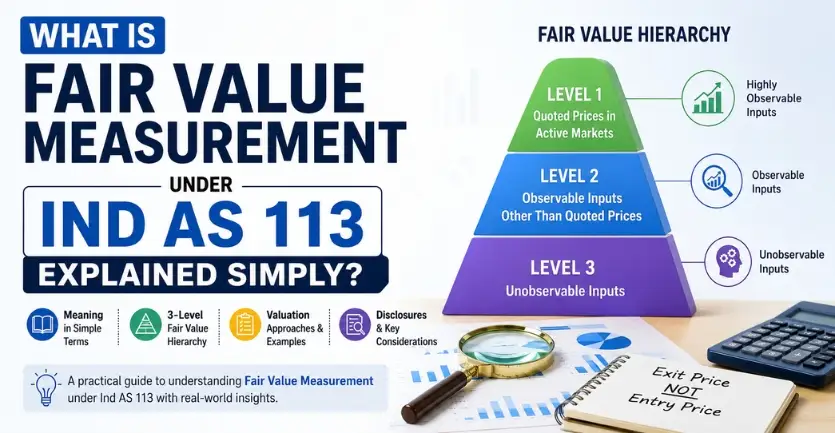
The Three-Level Fair Value Hierarchy
This is where most of the complexity lives, and where most explanations start to lose people. The hierarchy is actually logical once you understand the underlying principle: use the most observable, market-based inputs you can find.
Level 1 – Quoted Prices in Active Markets
The most reliable inputs. If your asset or liability has an actively traded market with publicly available prices, you use those. Think:
- Listed equity shares traded on BSE or NSE
- Government securities with daily price quotes
- Commodity futures with published exchange prices
There is almost no judgment involved at Level 1. The market tells you the price. Your job is to look it up.
Where Indian companies sometimes go wrong: treating a thinly traded stock as a Level 1 asset. If a share trades three times a week with large bid-ask spreads, that is not an active market. It would typically fall to Level 2.
Level 2 – Observable Inputs Other Than Quoted Prices
Level 2 covers situations where there is no direct quoted price for your specific asset, but you can still rely heavily on observable market data. The valuation involves some calculation, but the inputs are not guesses.
Common Level 2 situations:
- An interest rate swap valued using observable benchmark rates (like MIFOR or SOFR for cross-currency deals)
- Corporate bonds with limited trading, priced using yield curves from comparable actively-traded bonds
- A building valued using market rent per square foot derived from comparable lease transactions
The key word is comparable. You are using market evidence from similar assets or transactions and adjusting for differences. The adjustments should be minor and supportable.
Level 3 – Unobservable Inputs
Level 3 kicks in when observable market data is thin or nonexistent. The preparer has to make assumptions about what market participants would assume – which requires judgment, documentation, and frankly, the most scrutiny from auditors.
Typical Level 3 situations in India:
- Valuing equity in an unlisted private company (very common for Ind AS 109 / ESOP valuations)
- Intangible assets like customer relationships or brand value in a purchase price allocation
- Complex financial instruments with bespoke terms
- Real estate in markets where comparable transactions are genuinely scarce
At Level 3, the DCF (Discounted Cash Flow) method tends to dominate. You are building a model with assumptions about revenue growth, margins, terminal value, and discount rate – none of which the market tells you directly. That is not inherently wrong. But the assumptions need to be reasonable, documented, and defensible.
The “Exit Price” Concept: A Common Source of Confusion
Fair value is explicitly an exit price – the price to sell the asset or transfer the liability – not an entry price (what you paid to acquire it).
This distinction matters practically. Say your company paid ₹50 crore for a specialized piece of manufacturing equipment. That was your entry price. If you tried to sell that same equipment today, maybe you would get ₹30 crore because the market for it is thin and buyers would apply a discount for the specialized nature. The fair value is ₹30 crore, not ₹50 crore.
Many companies instinctively anchor to what they paid. Ind AS 113 requires them to think instead about what a market would pay.
Principal Market vs Most Advantageous Market
Ind AS 113 asks: which market are you measuring in?
The principal market is where the asset is most frequently traded – the highest volume, most active market. You should use that market even if a different market would give you a slightly better price.
If there is no principal market (or you cannot identify one), you fall back to the most advantageous market – the one that maximizes the price you’d receive after transaction costs.
For most listed securities, this is straightforward. For unlisted assets, it requires judgment, and the standard expects you to document your reasoning.
Non-Financial Assets: The “Highest and Best Use” Requirement
For non-financial assets – property, equipment, intangibles – Ind AS 113 introduces the concept of highest and best use.
Fair value is measured based on what a market participant would do with the asset, even if the current owner is using it differently. The question is: what use of this asset would maximize its value?
That use must be:
- Physically possible – the asset can actually be used that way
- Legally permissible – zoning, regulations, and contracts allow it
- Financially feasible – the use would generate adequate returns
A piece of land currently used as a parking lot might have the highest and best use as a commercial development site if zoning permits and the economics support it. In that case, fair value would be measured as a development site, not a parking lot.
This is one of the more practically complex parts of the standard, especially for real estate and infrastructure assets.
Disclosures: What Companies Must Reveal
Ind AS 113 has fairly detailed disclosure requirements, particularly for Level 3 measurements. Companies must disclose:
- The fair value hierarchy level for each class of asset/liability
- Valuation techniques and inputs used
- For Level 3: quantitative information about unobservable inputs
- Sensitivity analysis showing how fair value would change if key assumptions changed
- Transfers between hierarchy levels and the reasons for those transfers
The sensitivity disclosure for Level 3 is often the most informative piece for readers. If a small change in the discount rate assumption causes a large swing in fair value, that tells you something important about the reliability of the number.
In practice, Indian companies’ disclosures on this front vary widely in quality. Auditors have increasingly focused on ensuring these disclosures are actually useful – not boilerplate text that gets copy-pasted year to year.
Where Ind AS 113 Applies in Practice
Fair value measurement comes up more often than many finance teams realize:
Financial Instruments (Ind AS 109): Almost every company with loans, bonds, derivatives, or investments needs fair value measurement. Listed equity investments measured at FVTPL (fair value through profit or loss) or FVOCI (fair value through other comprehensive income) require this.
Business Combinations (Ind AS 103): When a company acquires another, the acquired assets and liabilities are measured at fair value on the acquisition date. This includes intangibles that were never on the seller’s balance sheet – customer lists, technology, brands. This is purchase price allocation (PPA), and it is entirely driven by Ind AS 113.
Investment Property (Ind AS 40): Companies that choose the fair value model for investment property need fair value measurements at each reporting date.
ESOPs and Share-Based Payments (Ind AS 102): The fair value of equity instruments granted to employees on the grant date. Typically a Level 3 measurement for unlisted companies.
Impairment Testing (Ind AS 36): Fair value less costs of disposal is one of the two methods for determining the recoverable amount of assets.
The Most Common Mistakes (And What Good Practice Looks Like)
After working on valuations across sectors in India, a few recurring issues show up:
Using book value as a proxy for fair value: Book value reflects historical cost minus depreciation. It is almost never the same as fair value, and using it as a shortcut does not comply with Ind AS 113.
Confusing transaction price with fair value: The price paid in a recent transaction may be evidence of fair value – but it is not automatically equal to it, especially if the transaction was between related parties or involved special considerations.
Poor documentation for Level 3 inputs: The inputs need to be documented clearly enough that another valuer could understand and challenge the assumptions. Vague statements like “industry growth rate assumed based on management estimates” do not pass scrutiny.
Ignoring market conditions at the measurement date: If the measurement date falls during a period of market stress, that stress is part of fair value. The standard does not let you assume market conditions you do not like.
Mechanical application of a single valuation method: Good practice typically involves cross-checking with at least one other method. A DCF without any market-based sanity check is weaker than one that also considers EV/EBITDA multiples from comparable companies.
A Practical Example: Valuing Unlisted Equity Under Ind AS 113
Company A holds a 15% stake in an unlisted manufacturing company, Company B. For its Ind AS financial statements, Company A needs to measure this at fair value.
Step 1 – Identify the hierarchy level: No quoted price exists. There are no recent arm’s-length transactions in Company B’s equity. This is a Level 3 measurement.
Step 2 – Choose valuation technique(s): Given Company B has stable, positive cash flows, the income approach (DCF) is primary. Company A also benchmarks using EV/EBITDA multiples from comparable listed peers.
Step 3 – Determine inputs: Revenue projections based on Company B’s business plan and industry outlook. EBITDA margins calibrated to peers. Terminal growth rate of 5% (India-specific, sector-informed). Discount rate derived from CAPM: risk-free rate (current 10-year G-Sec yield) + equity risk premium + size premium + company-specific risk premium.
Step 4 – Apply DLOM if appropriate: For a minority, illiquid stake, most market participants would apply a Discount for Lack of Marketability. The size of this discount is itself a judgment call – typically ranging from 15% to 35% for Indian private companies – and needs to be documented and defensible.
Step 5 – Disclose: The fair value, the technique used, the key inputs, and a sensitivity analysis showing the impact of ± 1% change in the discount rate.
This is what a compliant, defensible Level 3 measurement looks like.
Key Takeaways
Fair value measurement under Ind AS 113 is not just an accounting technicality. It affects how assets are reported on balance sheets, how acquisition prices get allocated, how ESOPs are expensed, and how impairment tests work. Getting it right matters – both for compliance and for the quality of financial information that investors, lenders, and regulators rely on.
The standard’s three-level hierarchy is built around a simple principle: use observable market data where you can, and when you cannot, be rigorous, transparent, and well-documented about the assumptions you make.
If your company is navigating a situation that requires fair value measurement – a fundraise, an acquisition, an ESOP grant, or a compliance valuation under Ind AS – the quality of the underlying valuation work determines the quality of the numbers that end up in your financial statements.
Frequently Asked Questions
Is Ind AS 113 mandatory for all companies?
Ind AS applies to companies that meet certain thresholds under the Companies (Indian Accounting Standards) Rules. Phase-wise implementation has covered listed companies, large unlisted companies, and their subsidiaries. If you are already preparing Ind AS financials, Ind AS 113 applies whenever another standard requires or permits fair value measurement.
What is the difference between fair value and market value?
Fair value under Ind AS 113 and market value as used in real estate or business valuation contexts are conceptually similar but not identical. Fair value is an accounting standard term with a precise definition. Market value as defined under international valuation standards (IVS) has a slightly different nuance, though in practice the two produce similar outcomes for most asset classes.
Do companies need an external valuer for every fair value measurement?
Not necessarily. For Level 1 measurements, no external value is needed – it is just a price lookup. For Level 2 and Level 3 measurements, companies may use internal teams, but for significant balances (especially in PPA, ESOPs, and material financial instruments), an independent external value provides credibility and helps withstand audit scrutiny.
How often must fair value be updated?
At each reporting date for assets and liabilities that are measured at fair value on a recurring basis. For non-recurring measurements (like in a business combination), it is measured once at the acquisition date.
